| posted November2007 |
|
2007-2008 Books and Lectures background page This web page is for the convenience of reporters, book review editors, bookstores arranging display advertising, lecture arrangers, my book publishers, and the like (who automatically have permission to reprint photos; others should consult by email). Two venues for the 2007-2008 evening climate lecture are shown below. |
William H.
Calvin |


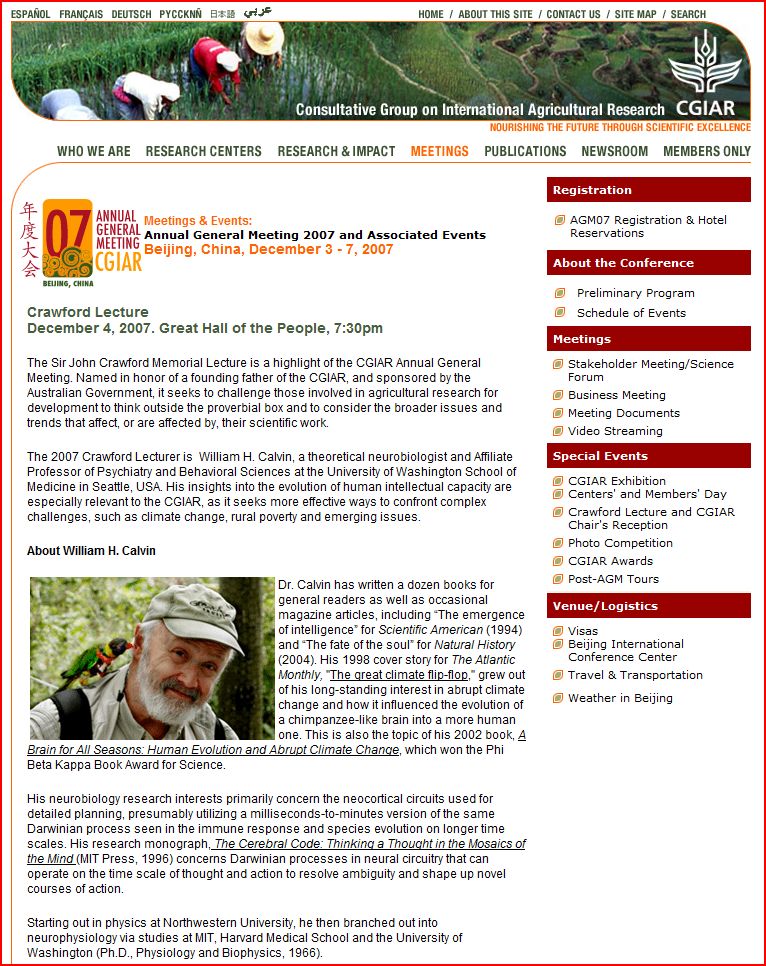
There is a printed version of the Beijing talk, both for A4 and US-sized printer paper.
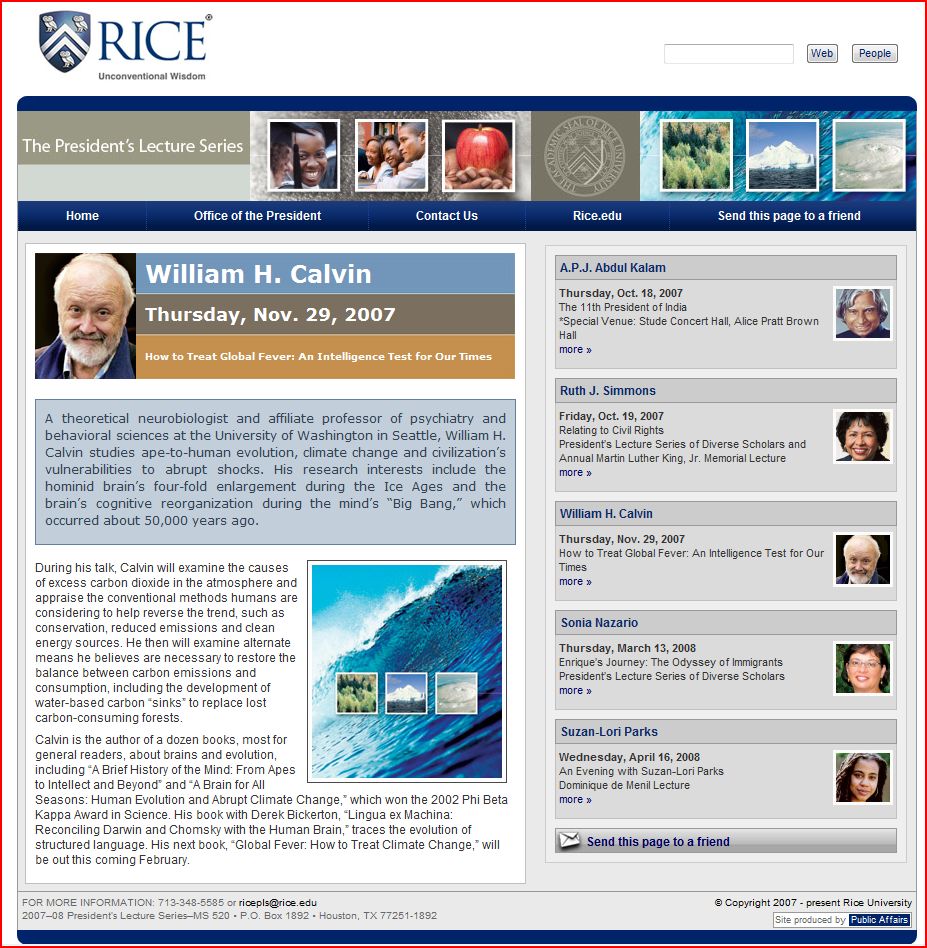
|
A Brain for All Seasons: Human Evolution and Abrupt Climate Change media inquiries should go to Erin Hogan at the University of Chicago Press 1.773.702-3714. If you need to speak with me, try email first. You can leave voicemail at 1.206.374.2260 which will be forwarded as an email attachment to me wherever I am traveling. Higher-resolution author pictures
Academic lecture arrangers who, to keep the bureaucracy happy, need a copy of an academic CV can get one in the UW School of Medicine's format, suitable for printing out but lacking hypertext links. Do include the home page URL in talk announcements
so people can read ahead: WilliamCalvin.com
Tag LinesI've spent a lot of time explaining to people that I'm not really a psychiatrist, despite being an Affiliate Professor Emeritus of Psychiatry and Behavioral Sciences -- just as I used to have to explain that I wasn't really a neurosurgeon. I'm really just a Ph.D. in physiology and biophysics with a long association with clinicians and zoologists. So I tend to steer people away from using formal academic titles. Here are several short-medium-long tag lines you can safely use: A Brain for All Seasons: Human Evolution and Abrupt Climate Change, brings his anthropology and climate interests back together again; it won the Phi Beta Kappa Book Award for Science. The latest book is Global Fever: How to Treat Climate Change. |
Click on a cover to read the book's web pages (full text, plus color illustrations in many cases)
of the Mind, 2004
2000
1996
1996
|

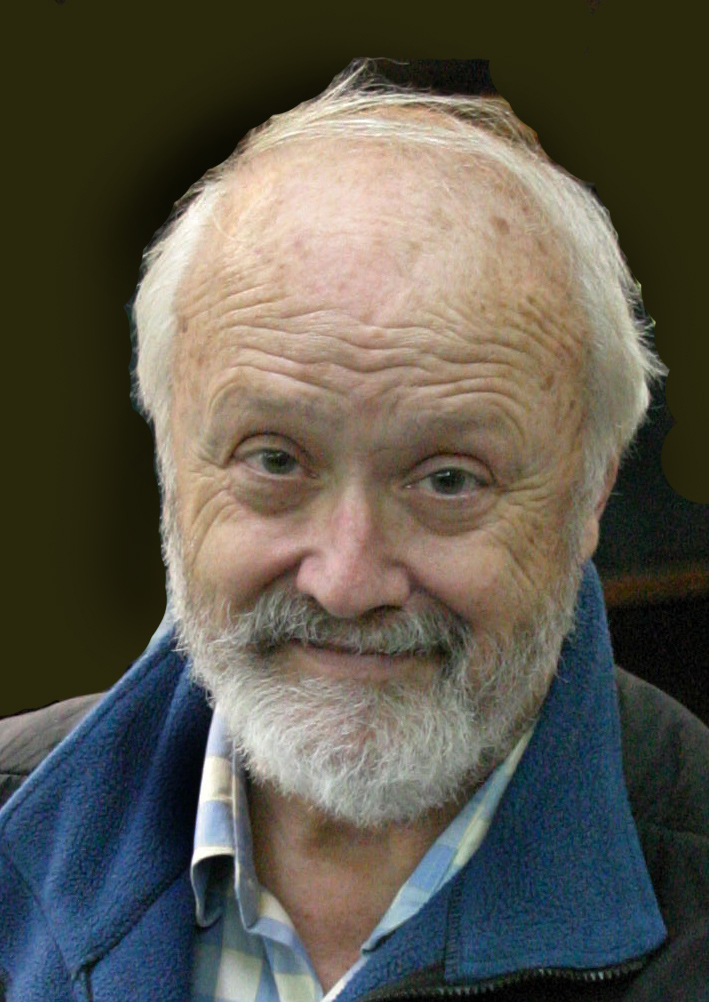
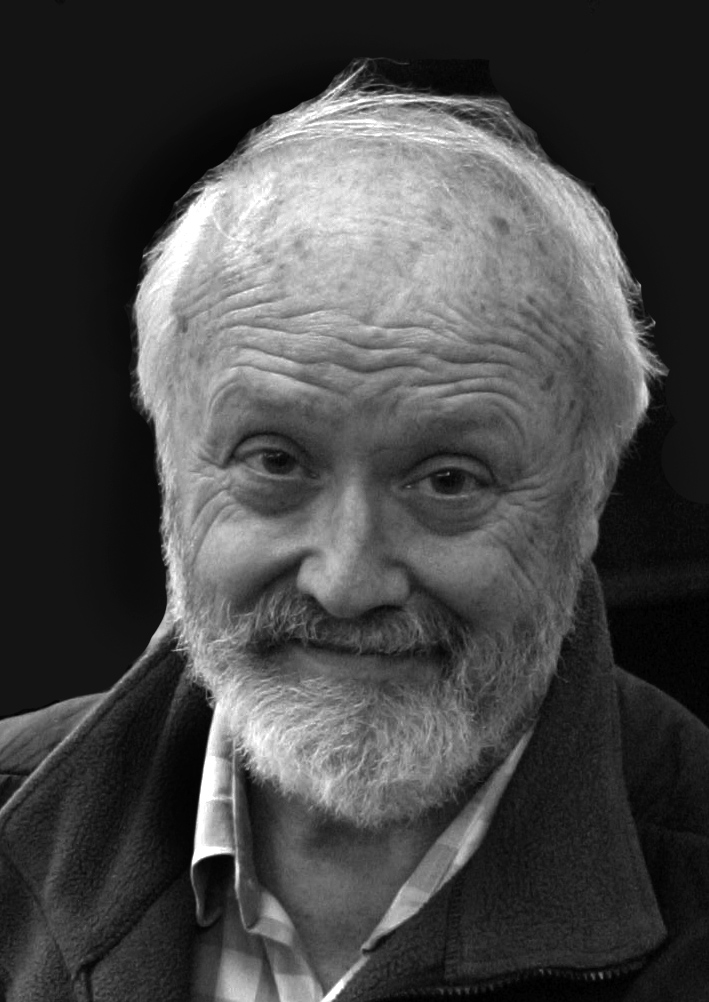
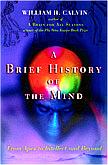


BioIf you prefer first-person narrative style: William H. Calvin, Ph.D. I started out in physics at Northwestern University, then branched out into neurophysiology via studies at MIT, Harvard Medical School, and the University of Washington (Ph.D., Physiology & Biophysics, 1966). I’ve had a long association with academic neurosurgeons and psychiatrists without ever having had to treat a patient. Lately I hang out with the paleoanthropologists and the climate scientists: my forthcoming book is Global Fever: How to Treat Climate Change. I am affiliate professor emeritus at the University of Washington School of Medicine in Seattle. I’m also affiliated with Emory University's great apes project and an advisor to the Foundation for the Future. My research interests primarily concern the neocortical circuits used for detailed planning and for improving the quality of the plan as you “get set,” presumably utilizing a milliseconds-to-minutes version of the same Darwinian process (copying competitions biased by natural selection) seen on longer time scales in the immune response and species evolution. My research monograph, The Cerebral Code: Thinking a Thought in the Mosaics of the Mind (MIT Press, 1996) concerns darwinian processes in neural circuitry that can operate on the time scale of thought and action to resolve ambiguity and shape up novel courses of action. My language book, a collaboration with the linguist Derek Bickerton, is about the evolution of syntax for long sentences and complicated thoughts, Lingua ex Machina: Reconciling Darwin and Chomsky with the Human Brain (MIT Press, 2000). By now I have written fourteen books for general readers. My occasional magazine articles include “The emergence of intelligence” for Scientific American (1994 and a 2006 revision) and “The fate of the soul” for Natural History (June 2004). My 1998 cover story for The Atlantic Monthly, "The great climate flip-flop," grew out of my long-standing interest in abrupt climate change and how it influenced the evolution of a chimpanzeelike brain into a more human one. Together, they are the topic of my 2002 book, A Brain for All Seasons: Human Evolution and Abrupt Climate Change; it won the Phi Beta Kappa Book Award for Science. A Brief History of the Mind: From Apes to Intellect and Beyond from Oxford University Press (2004) addresses what led up to the “Mind’s Big Bang” about 50,000 years ago, a creative explosion compared to the very conservative trends in toolmaking over the previous 2.5 million years. That span featured two million-year-long periods without much progress – despite the growth in brain size. Not only was the brain increase apparently driven by something invisible to archaeology (perhaps cooperation, protolanguage, and throwing accuracy), but if bigger brains were capable of being more clever, it didn’t immediately carry over to toolmaking. The other big puzzle is that our species, Homo sapiens, big brain and all, was around for perhaps 150,000 years without doing too much that was different from their predecessors and from Neanderthals. Our big brain may (or may not) be essential for our higher intellectual functions (creative structured thought), but it sure isn’t sufficient. It looks as if our old hardware evolved a much-improved operating system about 50,000 years ago and that we still haven't gotten the bugs out of it.
William H. Calvin, Ph.D., is a professor at the University of Washington School of Medicine affiliated with the Program on Climate Change. He is the author of Global Fever: How to Treat Climate Change (University of Chicago Press 2008, see Global-Fever.org) and thirteen earlier books for general readers. He studies brain circuitry, ape-to-human evolution, climate change, and civilization’s vulnerability to abrupt shocks. In Global Fever, he writes: "The climate doctors have been consulted; the lab reports have come back. Now it’s time to pull together the Big Picture and discuss treatment options. At a time when architects are thinking ahead to more efficient buildings and power planners are extolling the virtues of “renewable energy,” the climate modelers have discovered that long-term planning will no longer suffice. Our fossil fuel fiasco has already painted us into a corner such that, if we don’t make substantial near-term gains before 2020, the long-term is pre-empted, the efforts all for naught. We are already in dangerous territory and have to act quickly to avoid triggering widespread catastrophes. The only good analogy is arming for a great war, doing what must be done regardless of cost and convenience." His climate talk in Beijing at the Great Hall of the People is available in streaming video from the World Bank (links at WilliamCalvin.org) as are other lectures at NASA and Rice University.
A third-person bio for a more academic audience:William H. Calvin, Ph.D. He started out at Northwestern University, graduating with honors in physics in 1961, then spent a year at MIT and Harvard Medical School exploring what later became neurobiology. His Ph.D. was in Physiology & Biophysics at the University of Washington in 1966, under Charles F. Stevens. He has been on the faculty of the University of Washington since then, with a year as Visiting Professor of Neurobiology at the Hebrew University of Jerusalem. He is perhaps best known for fourteen books on brains, evolution, and climate, mostly written for general readers. Two are research monographs, both from MIT Press. The Cerebral Code (1996) was on the neural circuitry of cerebral cortex needed for creating a high-quality plan of action, such as a novel sentence to speak aloud. This was followed by Lingua ex machina (2000) on what brain circuitry is needed for Chomsky’s Universal Grammar. Written with the linguist Derek Bickerton, it shows the intersection of neuroscience with linguistics and the study of human origins. His interest in brain circuitry for planning novel movements of high quality led him to look at how evolutionary processes created new species and improved their “fit” with the environment. He focused on evolution as a process and started writing about his “six essential features” of a process that bootstraps quality -- and the speciation that can subsequently prevent backsliding. Seeing a need for speed in the neural circuitry, he sought an analogy in what had made the human brain enlargement so rapid (three-fold in only 2.5 million years). Climate change speeds up evolution, so back in 1984 he started going to paleoclimate lectures by the ice-core researchers. This led to his cover story in the Atlantic Monthly (January 1998), “The great climate flip-flop.” It concerns the abrupt climate flips that have occurred several dozen times in the last 100,000 years. He explained how global warming could trigger the next flip from our present warm-and-wet mode into a cool-dry-windy-dusty climate mode (essentially a devastating worldwide drought, developing in 5-10 years’ time). He enjoys piecing together scientific stories that involve several disciplines. A Brain for All Seasons: Human Evolution and Abrupt Climate Change, his 2002 book from the University of Chicago Press did just that, looking at paleoanthropology and evolutionary dynamics to see how something might have resonated with the abrupt climate changes every few thousand years. Its final chapters are about the future prospects for our civilization and how we must shore it up against sudden shocks – not just climate flips but also pandemics, bioterrorism, and financial panics – much as cathedrals were shored up a thousand years ago using flying buttresses. The public policy theme continues in his 2004 book from Oxford University Press, A Brief History of the Mind: From Apes to Intellect and Beyond. “Where does mind go from here, its powers extended by science-enhanced education and new tools – but with its slowly-evolving gut instincts still firmly anchored to the ice ages? We will likely shift mental gears again, into juggling more concepts simultaneously and making decisions even faster – but the faster you go, the more danger of spinning out of control. Ethics, morals, a sense of what’s right are possible only because of a human level of ability to speculate about the future and modify our possible actions accordingly. Though science increasingly serves as our headlights, we are out driving them, going faster than we can react effectively.” The latest book is Global Fever: How to Treat Climate Change.
Articles about William H. Calvin E. Simon Hanson, "An interview with William H. Calvin," at www.brainconnection.com (2000). See also http://WilliamCalvin.com/2000/brainconnection.htm. The Atlantic Monthly's Editor's Column "77 NORTH WASHINGTON STREET" The OMNI Magazine Prime Time interview bio is at http://www.omnimag.com/talk/bios/wcalvin.html The San Diego Union-Tribune had an excellent feature story by Mark Sauer in their May 22, 1996 issue, using baseball as a lead into the throwing theory for language origins.
There's a feature in the
Los Angeles Times.
|
To order a
copy of one of my more recent books, click on a cover for the link to amazon.com.
of the Mind, 2004
2000
1996
1996
|


Copyright ©2007 by William H. Calvin